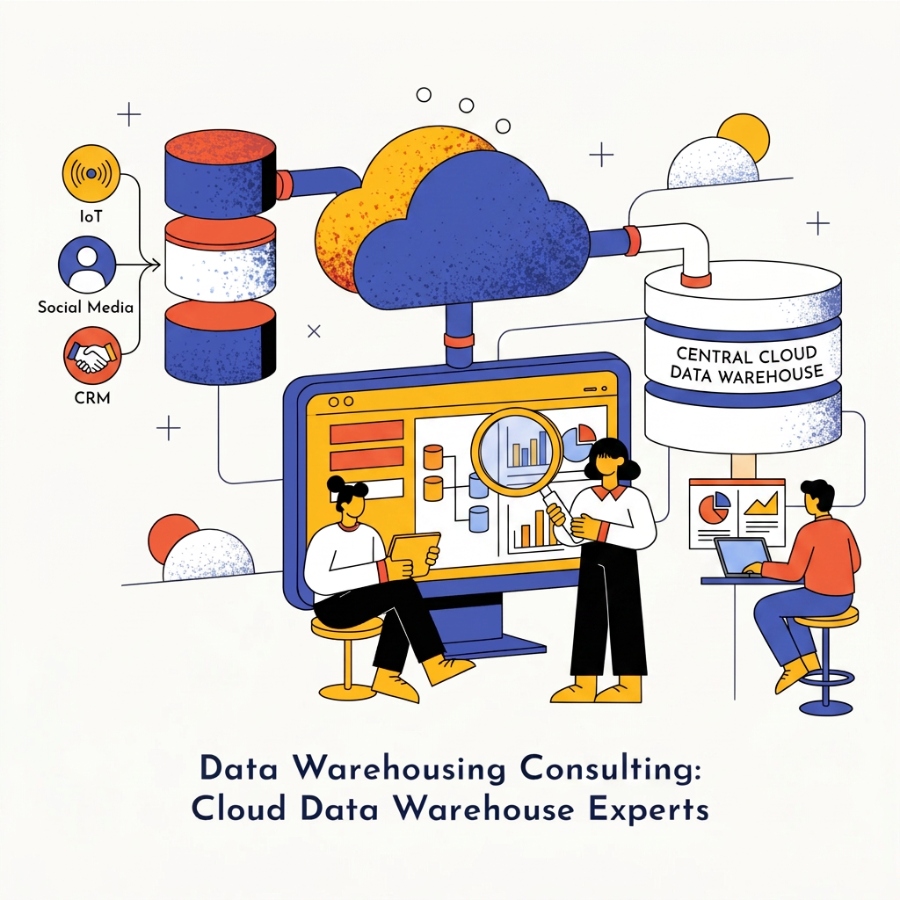
Your data is a valuable asset, but only if it’s usable.
Most companies have a huge amount of data. This data comes from their sales tools, finance applications, customer information systems, and their ERP and CRM solutions.
But the problem is that all this data is siloed. Different departments collect different statistics. Reporting is inefficient and takes too much time. Decisions are made based on the wrong information.
This is where data warehousing consulting comes in. A skilled consultant can help you design a system that brings all of your data together in one place—a single source of information that everyone on your team can rely on.
This guide explains what data warehousing consulting is, what its professionals do, and how to choose the right consultant for your needs.
Data Warehousing Consulting
What Is Data Warehousing Consulting?
Data warehousing consulting is a specialized service that helps you build and manage a data warehouse.
Consultants will work with your company from the very beginning. They will understand your goals and requirements. They will analyze your data sources and create a solution that meets your needs.
Next, they will build, test, and deploy the data warehouse. And they will be involved with it even after it is deployed.
This includes not only technical issues, but also much more:
- Strategic planning and vision
- Architecture and data modeling
- Data integration and ETL
- Data quality and governance
- Security and compliance
- Maintenance and optimization
Effective data warehousing consulting is not a technical process, but rather a business process. Its goal is to improve decision-making.
Cloud vs. On-Premise: Which One Is Right for You?
This is usually the first big question in data warehousing consulting.
On-premise refers to your data warehouse, which is located on your own server. In this case, everything is under your control, but you are responsible for the hardware costs and maintenance.
Cloud means that the data warehouse is hosted online. In this case, you do not have any hardware costs and do not need to maintain the server. You can scale it up when you need more performance and scale it down when you do not.
Hybrid refers to getting the best of both worlds: you keep some data on-premises and some data in the cloud.
Most companies these days start their operations with a cloud warehouse.
Top Cloud Data Warehouse Platforms
Our data warehousing consulting team can help you choose the best platform. Let’s take a quick look at some of the most popular platforms.
Snowflake is great and easy to manage. It scales up in seconds. It works on AWS, Azure, and Google Cloud. It’s a great choice for teams with erratic workloads.
Microsoft Azure Synapse combines storage, big data, and analytics. It works great with Power BI and Microsoft software. It’s a great choice for teams using Azure.
Amazon Redshift was built for AWS’s scalable workloads. It’s very powerful and integrates easily with other Amazon software.
Google BigQuery is completely serverless. You don’t have to worry about servers. Its queries run fast. It also works great with Google software.
Databricks can handle heavy workloads and run AI pipelines. It works quickly on large data sets. It is a good choice for teams with heavy computational workloads.
Microsoft Fabric is a relatively new all-in-one solution from Microsoft. It combines data engineering, data warehousing, and analytics into a single platform.
The best data warehousing consultants are not platform-dependent. They make decisions based on your needs.
What Does a Data Warehousing Consulting Team Actually Do?
Let’s take a closer look at how the process works.
Step 1 – Business Analysis
First, you need to know about your business. What should you measure? What decisions need to be made quickly? What information do you already have?
In a data warehousing consulting session, experts conduct workshops for your stakeholders and assess your needs, KPIs, and existing data infrastructure.
Step 2 – Data Warehouse Architecture Design
Next, it’s time to think about your data warehouse architecture. This step includes platform selection, data modeling, and pipeline design.
Your architecture should be aligned with your business processes. It should work well with your current and future data volumes.
Step 3 – Data Integration
Your data sources are now connected to the warehouse. Your CRM, ERP, applications, and databases—all your data are loaded into the warehouse.
ETL tools like Informatica, Azure Data Factory, and Talend are used for data integration. Raw data comes in, and refined data comes out.
Step 4: Data Governance and Security
Here, you define the rules for how your data will be managed. Who can see it? Who can change it? Who can store it?
Good data governance helps you keep your data organized and standardized. It ensures that your data complies with GDPR, CCPA, and other regulations. It also ensures the security of your data.
A data warehousing consulting team creates a governance structure from the beginning. This is not something that is done halfway.
Step 5: Testing and Rollout
Before going live, there is a lot of testing to do. Reports will be generated. Data will be verified. Performance will be measured.
Next, the team begins the rollout process one department at a time. Feedback will be collected and addressed. Then the rollout process is expanded further.
Step 6: Ongoing Support
The work doesn’t end there. Your data warehousing consultancy will be there for you.
They monitor your database. They troubleshoot performance issues. They add new data sources as your company grows.
Key Benefits of Data Warehousing Consulting
Working with professionals yields faster results. This means you get:
Reliable source of information: All teams work using the same, accurate data. No need to worry about conflicting statistics.
Faster decision-making: Reports that used to take hours to create can now be created in seconds. You work based on up-to-date data.
Improved data quality: Errors are detected early. Duplicate data is eliminated. Your data remains accurate.
Improved compliance: Built-in controls protect you from data breaches and compliance fines.
Overall cost reduction: Cloud platforms save on hardware costs. Automation saves on manual data processing costs.
Flexible system: Your data warehouse grows with your business. No need to build anything new in the future.
Who Needs Data Warehousing Consulting?
Most companies fall into this category. Here are the best ways to know when you need a consultant.
Your employees can’t agree on your accounting. The finance department says one thing, and the sales department says another.
Your reports are taking too long to generate. It shouldn’t take days; it should take minutes.
Your data isn’t accurate, or the fields don’t match. There are too many duplicates in your data. You can’t trust your accounting.
You’re growing rapidly. You have new software and new places to store data. Your current system can’t handle these changes.
You’re migrating to the cloud. You need an expert to do it right the first time.
Why ExistBI for Data Warehousing Consulting?
ExistBI started implementing data warehousing projects in 2008. Since then, we have been working with more than 200 customers in more than 25 industries.
ExistBI does not use any particular platforms. We provide our services on Snowflake, Azure Synapse, Amazon Redshift, Google BigQuery, Databricks, Microsoft Fabric, IBM Netezza, and others. We choose the best solution based on their customers’ needs.
ExistBI implements all stages- Business assessment, Design, ETLs, Data governance, Security, Implementation, and Support without any outsourcing or handoff.
ExistBI has more than 300 professionals in the United States, the UK, Canada, and Europe. The main offices are located in Los Angeles, New York, London, and Berlin. ExistBI has already worked with NASA, Pfizer, Costco, Johns Hopkins, and Johnson & Johnson.
Whether you need a completely new implementation or migration from existing systems, ExistBI has the necessary experience.