Data drives your organization. But is it easy to use?
This is a challenge for most businesses. Data resides in ten different systems. Sales uses one system. Finance relies on another. And operations rely on yet another. And none of them can communicate with each other.
The result? Employees use different metrics. Managers rely on outdated data. Reports take a long time to generate. And no one is completely sure of the results. The bottom line is that it’s expensive, limits growth, and leads to errors that could have been avoided.
Data warehouse implementation solves all of these problems. It collects data from all of your systems and brings it into one. It cleans the data. It organizes the data. It updates the data. And now your employees are working from a single database and a single set of metrics.
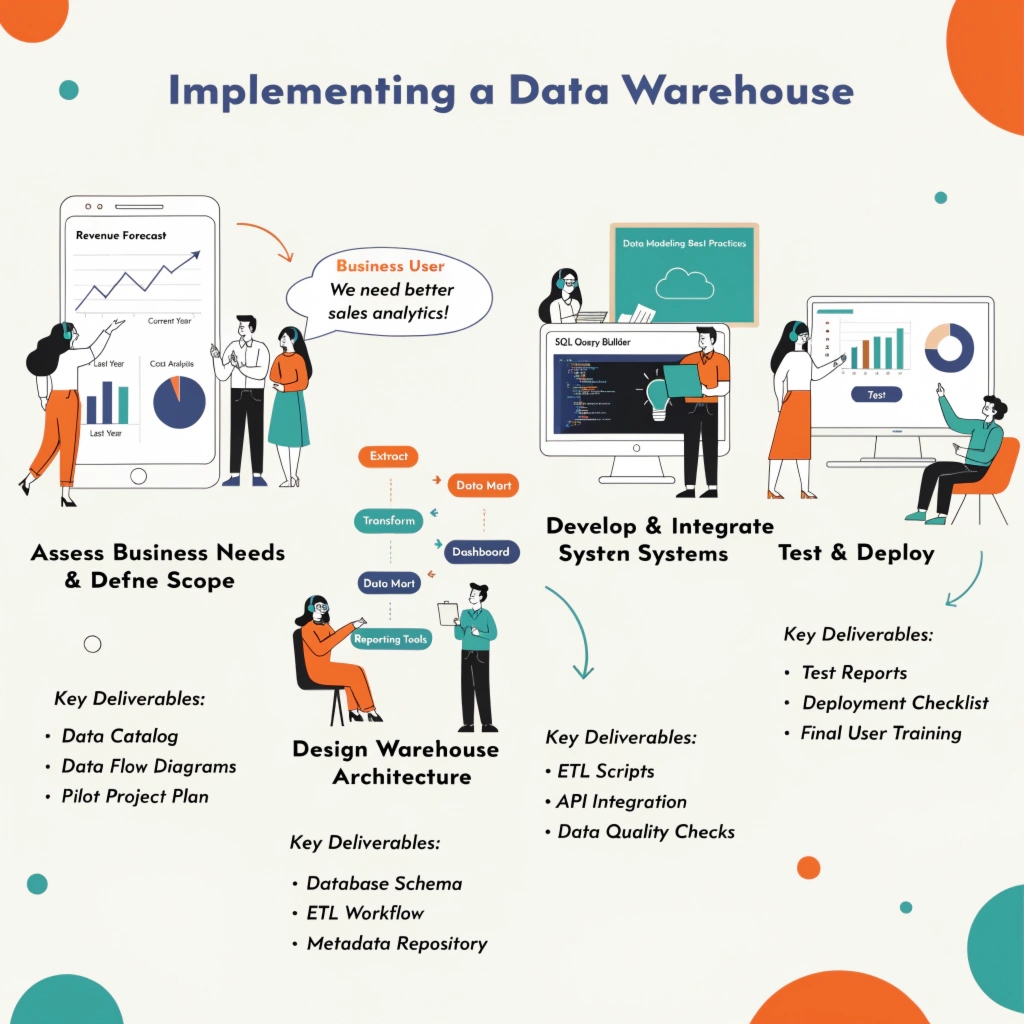
Here’s a step-by-step guide to the process.
Data Warehouse Implementation
What Is Data Warehouse Implementation?
Data warehousing refers to storing data from multiple applications, databases, CRM, or ERP systems in a single location. In this case, the data warehouse serves as a centralized repository for all business data.
The process of data warehouse implementation includes planning, design, connecting data sources, creating data pipelines, testing, and finally deployment. Although it is an IT activity, its impact affects the entire company.
Sales teams will receive real-time revenue data. Finance departments will receive reliable cost reports, and leaders will be able to see real-time data trends. In general, everyone will be able to work faster and with more confidence.
In addition, a data warehouse implementation sets guidelines for how the data should be used. This includes, among other things, setting access permissions, defining update procedures, and data retention.
This is not a one-time project, as good data warehouse implementations are scalable. Over time, it consumes more data and more sources, yet remains effective for many years.
Who Needs Data Warehouse Implementation?
Short answer: Any organization that relies on data.
Here are some clear signs that it’s time to implement it. Your departments work with disparate data. The sales department doesn’t listen to the finance department. There’s no consensus. Your reports take a long time to generate. You have to wait hours or even days for a simple answer. But the answer never comes on time.
Your data is inconsistent. There are duplicates or repetitions in everything. Inconsistent fields and numbers are unreliable. You’re expanding too quickly. You’re acquiring new materials and entering new markets, collecting more and more data. Your existing systems can’t keep up.
You’re having to make important decisions based on guesswork because your data is unreliable.
Data warehouse implementation solves all of these problems. It’s perfect for any small team or large organization. Every industry can use it: retail, finance, healthcare, manufacturing, logistics, and government. Everyone can benefit from this.
Step 1: Define Your Goals
All successful data warehouse implementations start with clearly defined objectives.
What do you want to achieve? Improved reporting? More accurate forecasting? A unified picture of your customers?
Document these. Gather input from your key departments. For example: sales, finance, operations, marketing.
The following information is required for this stage:
- What questions about your business do you need to answer?
- What data sources do you currently have?
- Who will use this warehouse and how often?
- What will success look like after six months?
- What is your budget and schedule?
Everything else falls short without these objectives.
Step 2: Audit Your Data Sources
Now think about your data. Where is it currently stored?
Most of it is scattered around. In your CRM. In your ERP. In your sales system. On your website. In your financial apps.
You need to create an outline of all of this. What kind of data is being stored? How good is its quality? Is it error-free? Up-to-date? Complete?
This audit is crucial. It will determine how you design your data model. It will also help you find problems now rather than later.
Step 3: Choose Your Architecture
This is where you define the architecture of your data warehouse.
There are three main categories to learn about.
On-premises: Your data warehouse will be hosted on your company’s servers. Everything is under your control, but the hardware costs are high.
Cloud-based: Your data warehouse will be located in the cloud—you don’t have to maintain any hardware. Scalability is possible here as your needs change.
This is the most popular.
Hybrid: A combination of both on-premises and cloud. Best for organizations that can’t afford to move everything to the cloud at once.
Organizations typically start with a cloud-based warehouse. Platforms like Snowflake, Azure Synapse, Amazon Redshift, and Google BigQuery make this task very easy.
Step 4: Design Your Data Model
Your data model is your design. It determines how your data will be organized and connected.
Caution is required at this stage. If you get it wrong, your reporting performance will suffer. Your data will become difficult to access. And people will find ways to bypass it by not using the system.
An ideal data model is:
- Realistic about your actual business processes
- Quick and easy for frequent queries
- Flawlessly extensible
- Easy to combine related information
- Clean and well-labeled
Be sure to involve both your business and data department staff in this process.
Step 5: Build Your ETL Pipelines
ETL is an acronym for Extract, Transform, and Load.
It describes the process for moving data from your source system to your data warehouse.
Extract: Extracting data from your CRM, ERP, apps, etc.
Transform: Cleaning the data and correcting errors, removing duplicate data, standardizing formatting, and applying your business logic.
Load: Transferring the cleaned data to your warehouse at regular intervals or in real time as needed.
This step can be quite challenging and requires a suitable integration tool, such as Informatica or Azure Data Factory.
ETL pipelines help keep your data warehouse up to date and reliable.
Step 6: Set Up Data Governance
Data governance is the process of establishing guidelines for managing data.
It may not be the most exciting topic. But it is undoubtedly one of the most important. Without governance, your data warehouse quickly becomes messy. People use data in different ways. Terminology changes. Quality suffers. Trust is lost.
A proper governance framework should include the following:
- Ownership of distinct datasets
- Measures to measure and maintain data quality
- Access controls and reasons for access
- Data retention, retention periods, and deletion processes
- Compliance with various laws such as GDPR and CCPA
Make sure to establish these guidelines from the very beginning.
Step 7: Test Everything
Before going live, complete testing procedures.
- Run your reports.
- Verify your data numbers.
- Compare them to your source system.
- Identify where there are differences.
Also, test for speed. Can your data warehouse handle a heavy query without slowing down? How will multiple queries at the same time affect your speed?
Fix these issues immediately. There’s nothing worse than going live with faulty data.
Step 8: Go Live and Train Your Team
Launch day is not the end; it’s just the beginning. Build your data warehouse step by step. Start with a team or data set. Listen to feedback. Improve what’s not working. Expand from there. Train your team on the job:
- How will they create their own reports
- What your data model actually is
- The source of each data point
- Data quality issues
- A process for asking questions
An unused data warehouse is useless. Training makes this approach a habit.
Step 9: Monitor and Improve
There is no such thing as a complete data warehouse implementation. Every day, your technology changes. Your data sources change. Your user needs to change. Your query load increases. Hence, it is a continuous process.
For the best practice, keep monitoring your system. Keep an eye on slow queries. Measure the quality of your data. Audit your access logs. Update your model as you go. Include these things early in your plan.
How ExistBI Can Help
Data warehouse implementation is quite challenging. It requires the right tools, processes, and experience.
ExistBI has been implementing data warehouses since 2008. We have worked with over 200 clients across 25 industries. We are not platform-locked – we implement data warehouses on Snowflake, Microsoft Azure Synapse, Informatica, Amazon Redshift, Google BigQuery, Databricks, etc.
We cover all aspects of implementation, such as business assessment, architecture design, ETL pipeline development, data governance, testing, deployment, and maintenance.
We operate from Los Angeles, New York, Washington DC, London, and Berlin. We work for companies in the US, UK, Canada, and EMEA. Some of our past clients include NASA, Pfizer, Costco, Johns Hopkins, and Johnson & Johnson.
If you need a proper data warehouse implementation service, ExistBI is a strong option.