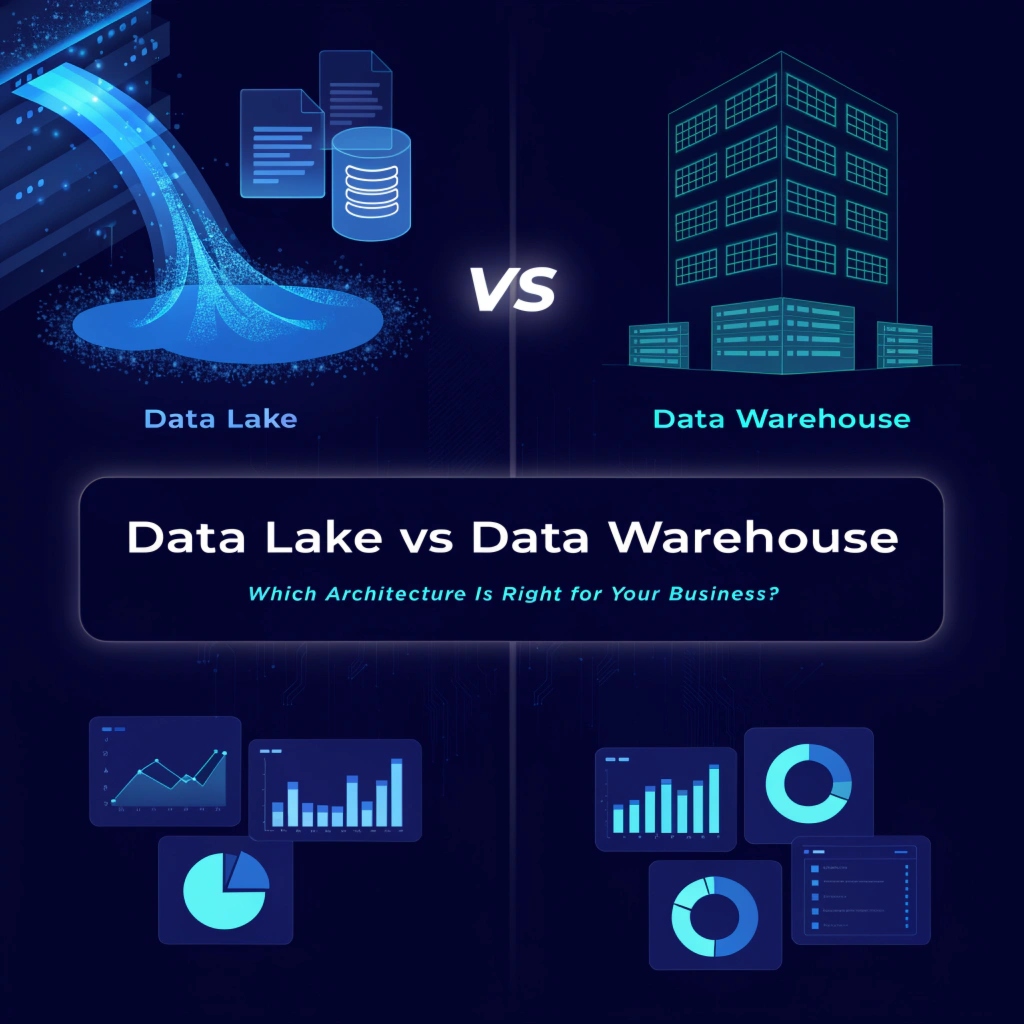
Data is the backbone of today’s Business. Every interaction, every transaction, and every operational process in an organization generates vast amounts of data. The problem isn’t collecting the data; it’s storing, managing, and extracting insights from it. As companies increasingly use analytics, artificial intelligence, and business intelligence, many managers face a choice: should they choose a data lake or a data warehouse?
The solution may not be simple. While both approaches can manage data, they also facilitate reporting and analysis, and there are fundamental differences in their functionality and goals. Understanding the differences between them can help your Business create a successful data strategy.
Data Lake vs Data Warehouse
What Is a Data Warehouse?
The data warehouse acts as the hub for organizing and cleaning the data. Data cleaning and organization are performed before loading into a data warehouse. In essence, a data warehouse is like a library, where all the books are properly organized. One can easily locate the required book by going to a particular location in the library. Data warehouses are used for:
- Creating executive dashboards
- Measuring sales and revenues
- Creation of financial statements
- Measuring performance over a period of time
- Business intelligence
The data being organized and cleaned means that business users can depend on it for accuracy without any technical knowledge.
What Is a Data Lake?
A data lake is a large-scale storage infrastructure for storing raw data of any type. Unlike a data warehouse, a data lake does not categorize or refine the data before storing it. It is loaded in its raw form and then organized. Some examples of data included in a data lake are:
- Customer data
- Website logs
- Videos/images
- Data collected by sensors
- Social media content
- App usage data
In other words, a data lake is a repository for storing almost any type of data. However, it takes more effort to find the required data. Data lakes are popular among data scientists, as they build ML models on them and run various experiments.
The Key Difference
Here it is in one sentence: a data warehouse stores clean, processed data; a data lake stores raw, unprocessed data.
| Data Warehouse | Data Lake | |
|---|---|---|
| Data format | Structured | Any format |
| Processing | Before storage | After storage |
| Best for | Business reports | Advanced analytics |
| Main users | Business teams | Data scientists |
| Query speed | Fast | Variable |
| Governance | Strong | Requires planning |
Neither option is better by default. The right choice depends on what your team needs to do with the data.
When a Data Warehouse Is the Right Choice
If your organization needs accurate information, a data warehouse is the best choice. For example, if your organization’s finance department generates monthly reports, they need data that they can trust. Similarly, if your company’s sales team monitors their targets, the data must be accurate every time. A data warehouse provides you with all of these. Therefore, choose a data warehouse if you need the following:
- Standardized reporting for all departments
- High-quality data and consistency
- Data governance and control
- Speed of queries for dashboards
- Reliable business metrics
Finance, management, and executive teams always prefer data warehouses because their data and results are accurate and trustworthy.
When a Data Lake Is the Right Choice
A data lake can be very useful when you want to run experiments on unstructured data sets. Some types of data are not easily organized into tables. For example, video recordings, sensor logs, and chat records: These won’t fit in a typical database. The beauty of a data lake is that it stores all of this data without adding any structure. Choose a data lake if you want to:
- Store massive amounts of data
- Complete machine learning projects
- Ingest data from multiple sources in real-time
- Explore data without building queries
- A repository for data that could be valuable in the future
Common users of data lakes include AI, data science, and research teams. Researchers need a place to conduct their research, and data lakes provide just that.
The Risks of Each Approach
Data Warehouse Risks
Building a data warehouse takes time. To make the information accessible, the data has to be modeled and converted to another format. When Business needs change rapidly, this causes delays in development. There is also the issue of data warehouse flexibility. A data warehouse is built using a specific set of queries. If a different query arises, some parts of the design will have to change. Another disadvantage of data warehouses is that, as data volume increases, costs also rise.
Data Lake Risks
Data lakes can quickly become chaotic. Without clear governance, a data lake becomes, in experts’ terms, a data swamp — where vast amounts of data have no clear structure, clear ownership, and no clear way to find the information you need. To avoid this, your team needs:
- Clear data governance policies
- Metadata management
- Security controls
- Data quality
- Defined ownership for each data set
Without these safeguards, a data lake becomes a liability rather than an asset.
A Third Option: The Lakehouse
Few businesses choose one of these two approaches, because they need both. And that’s why the Lakehouse architecture is gaining popularity.
Lakehouse combines the capabilities of a data lake and a data warehouse. It enables you to store large amounts of unstructured data while also enjoying the benefits of data governance, fast query execution, and reporting within the same infrastructure.
Lakehouse will help your company:
- Reduce the operational costs of managing two different infrastructures
- Ensure that all data users and scientists use the same technology
- Provide support for AI, analytics, and BI on the same platform
- Improve the quality of data without compromising its quality
In today’s environment, Lakehouse is probably the most realistic choice.
How to Choose
First, think about your goals for the analysis; what kind of questions do you want to answer using the data? If these questions are specific and repetitive, a data warehouse might be a good fit. If the questions are exploratory, a data lake might be a better choice.
Next, think about who will be using this data? Business analysts and executives will be more interested in using a data warehouse, while data scientists will prefer a data lake.
Think about how much data you already have; small amounts of structured data work well in a data warehouse. However, large amounts of unstructured and diverse data are better suited to a data lake.
Finally, consider your organization’s compliance requirements; a data warehouse ensures strong governance from the very beginning. If the answer to using both a data warehouse and a data lake is ‘yes’, then it makes sense to consider a lakehouse approach.
The Bottom Line
These two technologies are used to solve two different problems. Data warehousing provides you with reliable data for analysis and making important business decisions. Data lakes allow you to store any data you need for analysis and machine learning without imposing too many constraints. These two technologies are essential for most organizations. If you are working from scratch, it is better to build this architecture from the beginning than to redesign it later. The key here is not to choose the right technology, but to use your data effectively.