There is no shortage of information. Every communication channel, every transaction, and every process performed provides valuable information. However, for many organizations, extracting meaningful insights from this vast amount of data becomes difficult.
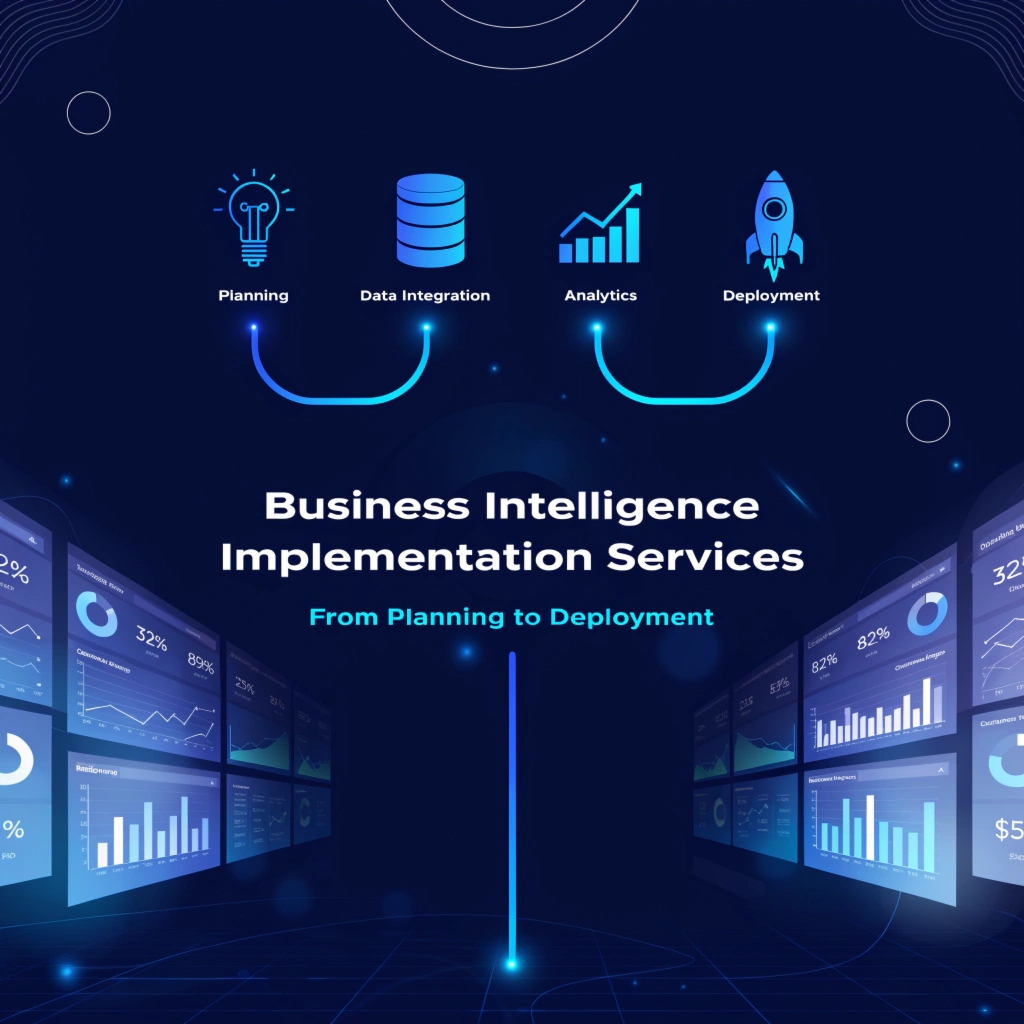
And this is where Business Intelligence Implementation Services comes in. A good Business Intelligence (BI) strategy is not just about getting reports. Its main purpose is to make better decisions, be more effective, identify opportunities, and have a clear understanding of your business performance. But to do all this, some steps need to be taken. This article will guide you through the process of Business Intelligence Implementation Services.
Business Intelligence Implementation Services
What Are Business Intelligence Implementation Services?
Business Intelligence Implementation refers to the design, development, and deployment of a system that transforms data into actionable insights.
This process includes the following components:
- Business Intelligence Assessment
- Strategy Development
- User Training
- Support and Optimization
- Requirements Gathering
- Dashboard and Report Creation
- Data Integration
- Data Warehouse Implementation
According to ExistBI, successful business intelligence systems provide reliable data throughout the information lifecycle, helping businesses evaluate data, identify problems, and make informed decisions. Companies that have the right approach to business intelligence often achieve higher performance.
Why BI Projects Fail Without Proper Planning
Many BI projects often fail because organizations focus on different tools without first identifying their business objectives. Having a dashboard alone is not enough to solve your business problems. Before choosing any solution, it is necessary to know the answers to some important questions:
- What types of decisions need to be made better?
- Who are the users of our dashboards?
- What KPIs should we track?
- How accurate is our data currently?
- What is the source of our data?
ExistBI‘s philosophy emphasizes the need for exploration, evaluation, and proper planning.
Phase 1: Discovery and Assessment
The process of implementing an effective BI system always begins with an analysis of the current situation.
As part of the discovery process, consultants analyze the company’s IT infrastructure, reporting processes, data sources, and business requirements. Representatives of various departments are interviewed to discuss reporting issues and information needs. The tasks that are usually completed during the discovery process are:
- Current situation analysis
- Technology assessment
- Data source assessment
- Gap analysis
- Stakeholder sessions
- KPI identification
The main idea is clear – understand your current and future position
. Otherwise, even the most sophisticated BI tool will not bring any success.
Phase 2: BI Strategy and Roadmap Development
After the assessment, the strategy is set. A Business Intelligence (BI) roadmap is the plan that defines how a company will move from data chaos to insight. This roadmap must include the following:
- Business objectives
- Milestones
- KPIs
- Requirements for data architecture
- Technical recommendations
- Governance policies
ExistBI’s consulting approach is based on identifying value-creating opportunities and creating action plans that align technical and business objectives. A well-structured roadmap reduces risk and ensures alignment between all stakeholders towards a common goal.
Phase 3: Technology and Platform Selection
Choosing the right BI platform is essential. Companies often make a serious mistake by using popular tools rather than choosing a BI solution tailored to their business needs. Some of the BI platforms currently in use are:
- Microsoft Power BI
- Cloud Data Platform
- Tableau
- Snowflake
- Informatica
- Microsoft Fabric
- IBM Analytics
The best option will depend on the amount of data, scalability, reporting needs, security concerns, and more. Technology evaluation helps companies make the right decisions, which saves money in the long run.
Phase 4: Data Integration and Data Warehousing
Business intelligence is only effective when its underlying data is strong. Many companies store data in multiple locations, including CRM systems, spreadsheets, ERP applications, cloud services, and operational database systems. Data integration is required to begin the data analysis process. The data integration process includes the following steps:
- Data extraction
- Data quality enhancement
- Data cleaning
- Data warehouse installation
- Data transformation
- ETL or ELT
ExistBI provides data integration, data migration, and data warehousing consulting services to help your company create a unified view of its information.
Phase 5: Dashboard and Report Development
Once the database structure is in place, an organization can create reports and dashboards. Good dashboards don’t just present numbers – they tell a story. The information business users need must be:
- Easy to understand
- Standardized across departments
- Applicable to their work
- Immediately accessible
Today’s BI solutions enable organizations to create interactive dashboards, which support self-service analytics and rapid decision-making.
With ExistBI, organizations can leverage analytics and visualization services to create effective reporting environments.
Phase 6: User Training and Adoption
Success won’t always come through technology alone. Users need to learn how to use the new BI environment effectively. This training should include the following areas:
- Navigating dashboards
- Self-service analytics
- Creating reports
- Monitoring KPIs
- Interpreting data
Companies that focus on user adoption get the most out of their BI investments. Above all, it’s necessary to create a data-driven culture.
Phase 7: Deployment and Continuous Improvement
System deployment is not the end of the process. Business contexts change, new data sources become available, reporting requirements change, etc. Successful businesses don’t just stop at deployment, but continually improve their BI setup through the following:
- Performance Monitoring
- Analytics Initiatives
- Data Quality Management
- Dashboard Improvement
- Data Governance Assessment
And by providing consulting and other valuable services after system deployment, ExistBI helps businesses get more out of their BI systems.
Common Benefits of Business Intelligence Implementation Services
Businesses that adopt a well-organized implementation strategy reap numerous benefits, including:
- Transparency of processes
- Data management
- Faster decision-making
- More accurate reporting
- Reduced labor required for reporting
- Compliance
- Deeper insights into customers
- Increased productivity
Above all, management can make better decisions based on reliable data.
Final Thoughts
In today’s world, Business Intelligence is no longer optional; it is a must-have for any organization that wants to improve. However, software alone does not guarantee success in such projects. A carefully planned approach, high-quality data, effective management, and an efficient implementation process are essential prerequisites for the success of a BI project. Professional Business Intelligence implementation services can help your company on its journey to gain valuable insights from unstructured data. Properly implemented Business Intelligence will not only provide you with information, but also become the basis for intelligent decision-making.