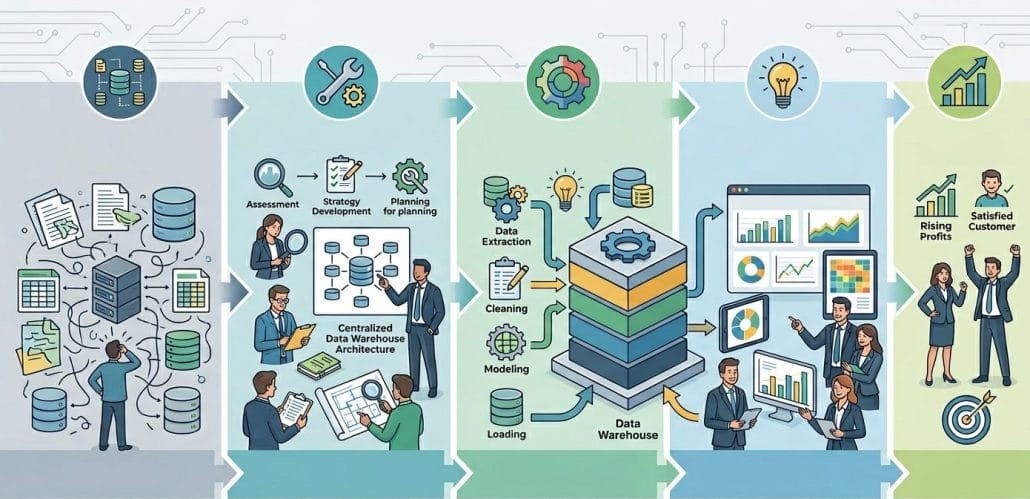
Business runs on data. Companies collect large amounts of data every day and turn it into useful insights. Nowadays every sale, customer action, and online click creates information. In that case, business intelligence becomes important. Many organizations face challenges to handle their growing data. Slow reports, dashboards may show incorrect numbers, and different teams may see different versions of the truth. These problems often happen because the data system is not well designed. Data Warehouse Consulting helps businesses solve these issues and build a strong foundation for business intelligence.
When companies use Data Warehouse Consulting services, they improve how data is stored, organized, and analyzed. This leads to faster insights, better decisions, and stronger business performance.
Existbi
Understanding the Role of Business Intelligence
Business intelligence is the process of using data to understand what is happening in a business. It helps companies track performance, identify trends, and make better decisions. Managers depend on business intelligence tools to monitor sales, customer behavior, marketing campaigns, and operational efficiency.
However, business intelligence tools work properly if given data is reliable.. If the data is scattered across many systems or stored in messy formats, reports will be unreliable. Teams may spend more time fixing data issues than analyzing insights.
This is where Data Warehouse Consulting is valuable. Consultants help businesses create a structured data environment where information from different sources is brought together, cleaned, and prepared for analysis.
A well-designed data warehouse becomes the central hub for business intelligence. It ensures that everyone in the organization performs with the same accurate data.
Why Many Businesses Struggle with Data
Many companies start their data journey with separate systems for sales, finance, marketing, and operations. Over time, these systems grow and become complex. Data is stored in multiple databases, spreadsheets, and applications.
When teams try to build reports from these unorganized systems, they face several problems. Data may be duplicated, incomplete, or outdated. Reports may take hours or even days to generate. Different departments may calculate numbers in different ways, which leads to confusion.
Without a proper data structure, business intelligence tools cannot deliver reliable insights. Decision-makers may hesitate to trust the reports they see.
Data Warehouse Consulting addresses these challenges by designing a unified data platform that integrates information from across the organization.
How Data Warehouse Consulting Improves Data Quality
One of the biggest benefits of Data Warehouse Consulting is improved data quality. Reliable data is the foundation of strong business intelligence.
Consultants analyze how data flows through an organization. They identify errors, duplicates, and inconsistencies in the existing data systems. Then they design processes that clean and standardize the data before it enters the data warehouse.
When data is consistent and accurate, reports become much more reliable. Teams no longer waste time fixing spreadsheets or verifying numbers. Instead, they can focus on understanding trends and making strategic decisions.
Better data quality also improves trust across the organization. When leaders know that reports are based on accurate information, they can make decisions with confidence.
Building a Strong Data Architecture
Another important role of Data Warehouse Consulting is designing a strong data architecture. A data warehouse must be structured in a way that supports fast queries and easy analysis.
Consultants design data models that organize information into clear and logical structures. This makes it easier for business intelligence tools to access the data and generate reports quickly.
A well-designed architecture also supports future growth. As businesses collect more data and add new systems, the data warehouse can expand without becoming slow or complicated.
This scalability is especially important in today’s digital economy where data volumes continue to grow rapidly.
Integrating Data from Multiple Sources
Modern organizations use many different software systems. Customer information may be stored in a CRM system, financial data in an accounting platform, and marketing data in analytics tools.
Without integration, these systems remain isolated from each other. This makes it difficult to see the full picture of business performance.
Data Warehouse Consulting helps integrate data from all these sources into a single platform. Consultants build data pipelines that automatically collect, transform, and load data into the warehouse.
Once the data is unified, business intelligence tools can analyze it together. For example, a company can connect marketing campaigns with sales results or track customer behavior across multiple channels.
This unified view provides deeper insights and helps businesses make smarter decisions.
Faster and More Reliable Reporting
Slow reporting is a common frustration in many organizations. Analysts often spend hours gathering data from different systems before they can even begin analysis.
With the help of Data Warehouse Consulting, businesses can automate much of this process. Data pipelines update the warehouse regularly, ensuring that reports always use fresh information.
Because the data warehouse is optimized for analytics, queries run much faster. Dashboards load quickly and reports can be generated in minutes instead of hours.
Faster reporting allows teams to respond quickly to changes in the market. Managers make strategies when needed by tracking performance in real time.
Supporting Advanced Analytics
Business intelligence is evolving beyond simple reports and dashboards. Many companies now want to explore predictive analytics, machine learning, and advanced data analysis.
These advanced capabilities require a well-organized data environment. Data scientists need clean and structured data to build accurate models.
Data Warehouse Consulting helps create the foundation for advanced analytics. By organizing and centralizing data, consultants make it easier for data scientists to access the information they need.
As a result, businesses can move from basic reporting to deeper insights that support innovation and growth.
Strengthening Data Governance and Security
Companies must protect sensitive information and ensure that data is used responsibly.
Data Warehouse Consulting helps organizations implement strong governance frameworks. Consultants apply rules for data access, usage, and management. They also ensure that security controls are in place to protect confidential information.
These estimates help businesses comply with regulations and reduce the risk of data breaches. At the same time, they maintain transparency and accountability across the organization. Strong governance also improves the reliability of business intelligence systems by ensuring that data is managed in a consistent way.
Creating a Data-Driven Culture
Technology alone cannot transform business intelligence. Companies also need a culture that values data-driven decision making.
When organizations invest in Data Warehouse Consulting, they decide a criteria of how teams use data. Employees gain easier access to reliable reports and dashboards. Leaders encourage decisions based on insights rather than assumptions
Over time, data becomes a central part of daily operations. Teams use insights to improve marketing campaigns, optimize supply chains, and enhance customer experiences.
This cultural shift helps businesses stay competitive in a rapidly changing market.
Conclusion
Business intelligence plays an important part in helping organizations understand their data and make better decisions. However, strong business intelligence depends on a well-designed data foundation.
Data Warehouse Consulting helps businesses build this foundation by improving data quality, integrating information from multiple systems, and designing scalable data architectures. It also enables faster reporting, advanced analytics, and stronger data governance.
Companies invest in Data Warehouse Consulting for transforming scattered data into valuable insights. This allows leaders to see the full picture of their operations and make decisions properly.
In today’s data-driven world, improving business intelligence is no longer optional. With the right data warehouse strategy, organizations can unlock the actual value of their data and drive long-term growth.