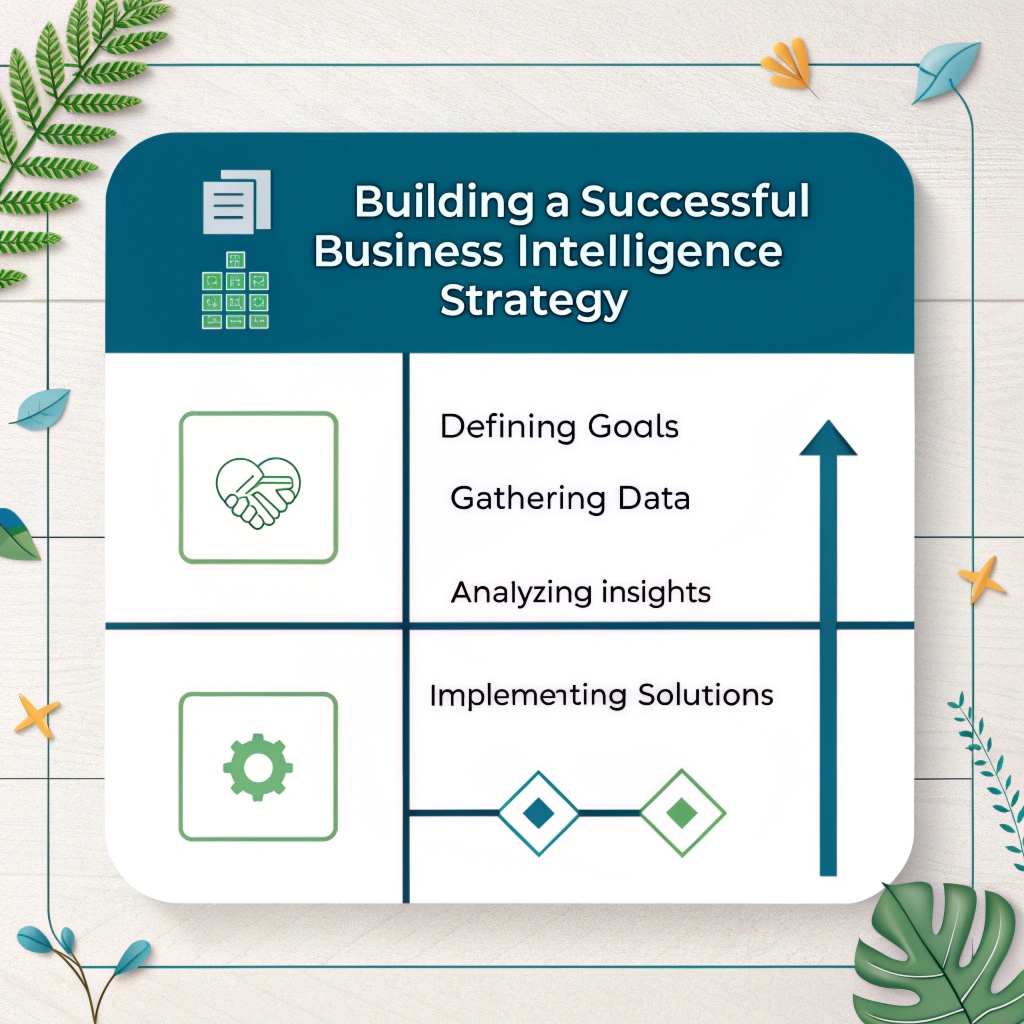
Today, Data plays a vital role in any organization. In the world, data-driven businesses generate huge amounts of data from sources such as sales platforms, ERP systems, customer interactions, supply chains, websites, and cloud-based applications. However, data alone does not help organizations profit and improve. To benefit from this huge amount of data, organizations need to make it actionable. This is where effective Business Intelligence (BI) plays a key role.
A good BI strategy can help companies effectively integrate and analyze their data, ensure proper governance, and implement analytics-enabled processes. ExistBI’s services enable organizations to implement advanced data warehousing, analytics, cloud migration, governance, predictive analytics, and reporting capabilities to transform their information environment.
However, creating an effective BI strategy is not limited to just collecting a few reports or creating dashboards.
Business Intelligence Strategy
Define Clear Business Objectives
Before creating an effective BI project, it is essential to understand the business problems that the organization is trying to solve. Most organizations get into trouble by prioritizing technology over business benefits. A good BI solution starts by determining what business objectives it needs to meet, such as:
- Increase efficiency
- Eliminate time wasted in reporting
- Increase revenue
- Deliver an improved customer experience
- Compliance and governance
- Predictive analytics
Business leaders, department heads, and IT must work together to identify KPIs and determine which insights will drive decision-making. According to ExistBI, one of the first steps in creating a good business intelligence solution is to evaluate the strategy and identify the stakeholders whose needs the program will meet. To achieve return on investment (ROI), BI initiatives must directly support organizational objectives.
Assess Existing Data Infrastructure
Before adopting new tools for business intelligence and analytics, an organization needs to review its existing data infrastructure. Today’s organizations often face fragmented solutions, duplicated information, poor reporting standards, and inconsistent data.
A data infrastructure assessment includes an analysis of the following:
- Existing databases and software applications
- ERP systems
- CRM systems
- Data integration
- Report management
- On-premises and cloud infrastructure
- Data quality and data governance
ExistBI emphasizes the importance of conducting a BI assessment and system audit before creating a solution roadmap.
Such assessments help determine whether a company needs to implement a legacy data warehouse, data lakehouse, cloud migration solution, or advanced data integration capabilities.
Centralize and Integrate Enterprise Data
Among the most important problems faced by organizations, the problem of disjointed data has become the main one. The process of integrating documents into computable data is complex, hindering their use.
To create an effective BI strategy, the organization needs to create a centralized storage based on N number of technological means:
- Data warehouse
- Data lake
- Lakehouse architecture
- Cloud-powered analytics platform
Like ExistBI, today’s implementation of a data lakehouse architecture uses more advanced analytics and company coding to store different types of data.
The data integration process is a crucial stage that needs to be completed. It includes connecting data sources from CRM, ERP, advertising, financial solutions, IoT devices, and external databases.
By creating a single data store, the organization will be able to retrieve the so-called “single version of the truth”.
Prioritize Data Quality and Governance
The effectiveness of business intelligence depends on the accuracy and quality of the data it uses. Poor-quality data can lead to inaccurate reports, poor forecasts, compliance issues, and poor business decisions.
Organizations need to implement rigorous data governance practices, which include:
- Data ownership and stewardship
- Privacy and security
- Data verification
- Data governance and compliance
- Data lifecycle management
According to ExistBI, data quality is the foundation of all successful data projects, and data accuracy, consistency, confidentiality, and reliability are critical.
Improved data governance helps organizations comply with data governance laws such as GDPR, HIPAA, and CCPA while also ensuring trust in the enterprise analytics platform. Efforts to improve data quality should include data profiling, data cleaning, standardization, and monitoring to ensure accurate data.
Choose the Right Business Intelligence and Analytics Tools
Choosing the right technology stack is another essential aspect of building an effective BI solution. Since companies have different needs for scalability, integration, and reporting capabilities, there is no one-size-fits-all solution.
The following criteria should be used when evaluating different solutions for business intelligence purposes:
- Scalability
- Compatibility with cloud services
- Ability to provide real-time analytics
- Visualization capabilities
- Support for AI and predictive analytics
- Integration capabilities
- Availability of the system for all types of users
When working on analytics and data modernization projects, we use a variety of technologies, including Microsoft Power BI, Tableau, Informatica, SAP, Azure Synapse Analytics, Snowflake, IBM, and Databricks.
Develop Actionable Dashboards and Reporting
One of the many benefits of BI is the need to simplify complex data sets. Organizations need to design a dashboard that clearly presents their operations using real-time data.
Some of the characteristics of a good dashboard are:
- Focus on important key performance indicators (KPIs)
- Uses easy-to-understand visualizations
- Enables real-time decision-making
- Enables deep exploration
- Role-based views
ExistBI Firm provides BI consulting services for creating dashboards and reporting systems.
Dashboards should provide insights without overwhelming users with excessive data.
Incorporate Advanced Analytics and AI
Today’s BI approach increasingly relies on predictive analytics, machine learning, and automation. While reporting describes what happened, business analytics enables an organization to see why something happened and what will happen next.
Some uses of predictive analytics include:
- Sales forecasting
- Behavioral analytics
- Fraud detection
- Supply chain optimization
- Risk management
- Operations forecasting
ExistBI offers a variety of services in predictive analytics and machine learning, which help organizations identify patterns, reduce costs, and improve through insights derived from past and current data.
Through such approaches, organizations can gain a competitive advantage over others by making faster decisions.
Promote a Data-Driven Culture
Technology alone is not enough to ensure the success of a BI initiative. Businesses should encourage their employees to use data in their decision-making process.
These include:
- Top management support
- End-user training
- Collaborative efforts across departments
- Use of self-service analytics
- Continuous improvement initiatives
ExistBI also highlights its supporting services that help businesses get the most out of their BI initiatives.
Having confidence and knowledge about data makes businesses more agile and efficient.
Conclusion
To create an effective business intelligence strategy, it is not enough to deploy the right reporting technology. An organization needs to create a roadmap that encompasses all elements, including business goals, data management and governance, analytics, and modernization of its technology infrastructure. An effective BI solution includes data consolidation to ensure high quality, integration of disparate systems, use of scalable BI technologies, and leveraging predictive analytics to transform data into business intelligence. Consulting firms specializing in BI and business analytics, such as ExistBI, can help businesses navigate this process.