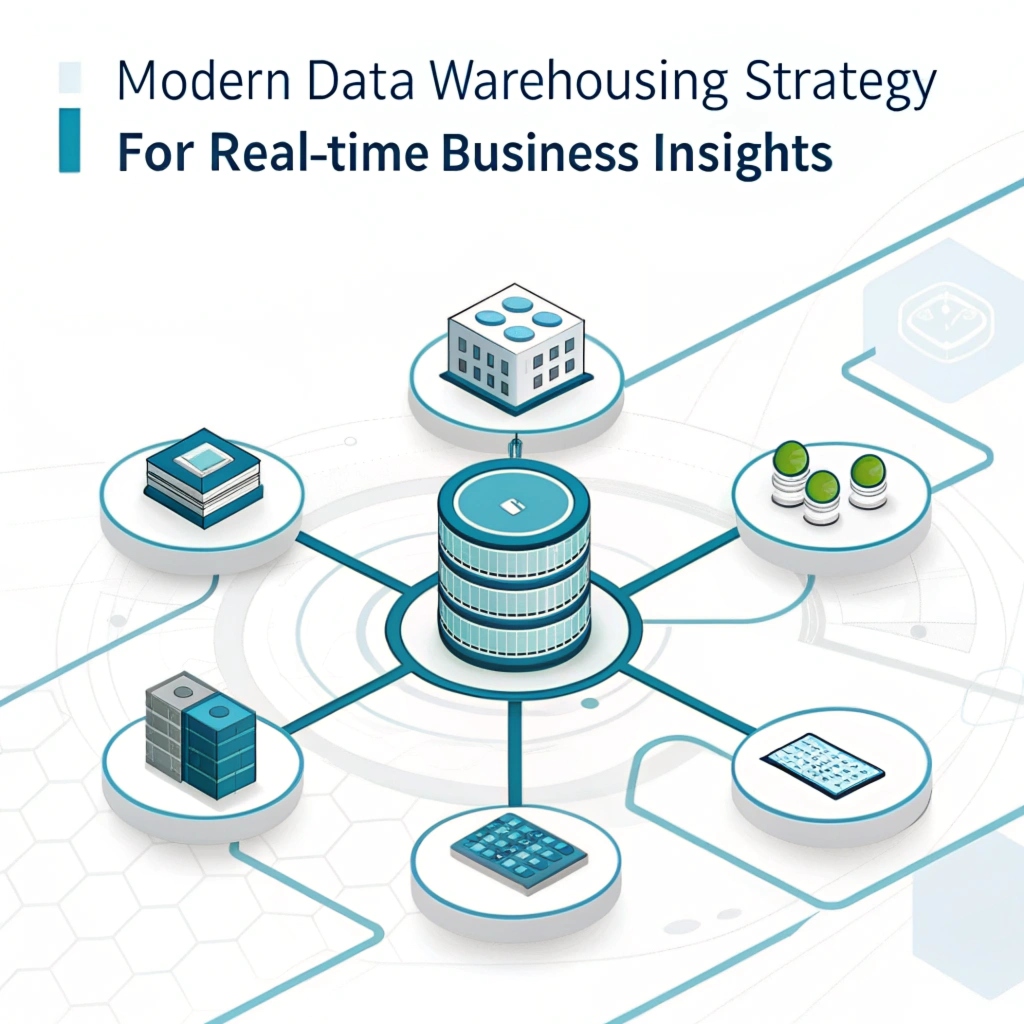
In the modern business world, data is the real game-changer in an organization. Businesses generate huge amounts of structured and unstructured data every second. But the real value of data is not in the fact that the company has collected a large amount; rather, it lies in analyzing and transforming it into actionable insights. This is where modern data warehousing can be applied as a revolution in data management. Modern data warehouses are no longer limited to collecting a company’s history; today, they are dynamic environments that collect data from diverse sources, deliver high-quality data, and support real-time operations. The consultancy services provided by ExistBI can help companies make the most of this.
Modern Data Warehousing Strategy
The Evolution of Data Warehousing
The traditional approach to building a data warehouse was primarily focused on reporting and analyzing historical data. It has proven effective in the past, but it has faced challenges such as scalability, data source diversity, and the need to process data in real time. Modern data warehousing strategies address these issues by combining data lakes, cloud computing environments, and lakehouses.
In modern data-warehouse implementation, companies can collect data from various sources into a single database and analyze it. According to ExistBI, creating such an environment enables trust in the data and its use for business decisions.
As a result, a hybrid architecture combines data warehousing and data lakes. These can work with both structured and unstructured data.
The Role of Data Warehousing Consulting
Establishing a modern data warehouse involves many aspects, including the right strategy, technical expertise, and industry knowledge. Data warehousing consulting helps organizations manage all phases of the data warehousing process.
The consulting process begins with an assessment of the organization’s systems, data sources, and business needs. Next, the consultants create a data architecture based on the organization’s priorities. ExistBI puts a lot of effort into the consulting process, which includes strategy formulation, data modeling, and data integration, among other areas.
Some of the key components of data warehousing consulting services are listed below:
- Strategy and data warehousing design
- Migration and integration to the cloud
- ETL/ELT process for data integration
- Data governance and quality management
- Data modeling and architectural optimization
With these consulting services, companies can build a robust data structure.
Real-Time Analytics: A Game Changer
One of the most important advances in contemporary data warehouses is the development of real-time analytics. Instead of using batch-processing systems common in the past, real-time analytics enables organizations to analyze and process data the moment it is created.
With this approach, organizations can quickly address challenges such as adapting to market trends, customer behavior, and other issues that arise in business operations. Real-time analytics can help track supply chains, detect fraud, create advanced pricing models, and increase customer engagement.
According to ExistBI, real-time analytics systems enable organizations to “monitor data as it flows,” allowing them to make quick decisions and take immediate action in response to changing circumstances.
Cloud and Modern Data Platforms
The advent of cloud computing is at the heart of contemporary data warehousing approaches. The cloud computing model offers scalability, flexibility, and affordability, making it suitable for businesses of all sizes.
As a consulting firm, ExistBI works closely with Microsoft Azure, AWS, Snowflake, Google Cloud, and other cutting-edge solutions to build a cloud data warehouse.
Cloud data warehousing systems have several advantages:
- Elastic scalability to hold large amounts of data
- Greater collaboration and availability
- Lower costs associated with infrastructure and maintenance
- Increased speed in deployment and implementation
In addition, modern solutions offer more sophisticated capabilities such as advanced analytics and machine learning.
Data Integration and Governance
Implementing an effective data warehousing approach requires efficient data integration and management. Organizations may encounter data from a variety of sources, such as ERP systems, Internet of Things technologies, CRM solutions, and third-party databases. Data integration is crucial for providing a holistic view of the organization’s processes and for facilitating data analysis.
On the one hand, data integration helps collect, transform, and load data into the warehouse. On the other hand, data governance strategies allow organizations to create a framework that ensures high-quality, secure, and consistent data.
According to ExistBI, implementing an effective data governance strategy is essential to maintaining data accuracy and security.
Business Benefits of Modern Data Warehousing
Modern data warehousing consulting offers numerous benefits.
Some of these benefits include:
Smart decision-making
Access to timely, high-quality data helps the leadership team make faster, more effective decisions.
Improved customer experience
Businesses can provide a better customer experience through real-time analytics.
Higher operational efficiency
When processes are less complex, data management becomes more efficient.
Higher revenue
A business can increase its revenue through improved customer targeting and pricing strategies.
Competitive advantage
Businesses can leverage data analytics to predict trends before their competitors.
According to ExistBI, organizations benefit from data warehousing by gaining actionable insights, optimizing processes, and increasing profits.
Industry Applications
Data warehousing and analytics are revolutionizing industries across the board. In the retail industry, companies are implementing analytics to gain insights into their customers’ behavior and better manage inventory. The healthcare sector is using real-time data to improve patient outcomes and become more efficient. The financial sector is implementing analytics to identify risks and prevent fraud. Expert advice ensures that these solutions meet the needs of various industries. With experience working in various industries, ExistBI creates tailor-made solutions to meet your business needs.
The Future of Data Warehousing
The future will see increasing innovation in data warehousing, driven by artificial intelligence, machine learning, and automation. The use of these innovations will improve the platform’s accuracy and predictive capabilities.
In addition, the popularity of lakehouses among organizations will increase, as they combine data warehouses and data lakes within a single platform. Lakehouses offer greater flexibility and performance than data lakes and warehouses.
Finally, the need for expert advice will also increase as companies place greater emphasis on data in strategic decision-making.
Conclusion
Modern data warehousing consulting is a key component to enable organizational transformation in the era of real-time analytics. With technology, cloud computing services, and expertise, organizations can fully leverage their data assets.
ExistBI helps businesses build future-proof and effective data ecosystems through a wide range of services, from strategy and integration to governance and analytics. Such systems can help organizations make better decisions and sustainably thrive in an increasingly competitive world. In this data-driven world, modern data warehousing is no longer just a technology solution; it is an essential requirement.