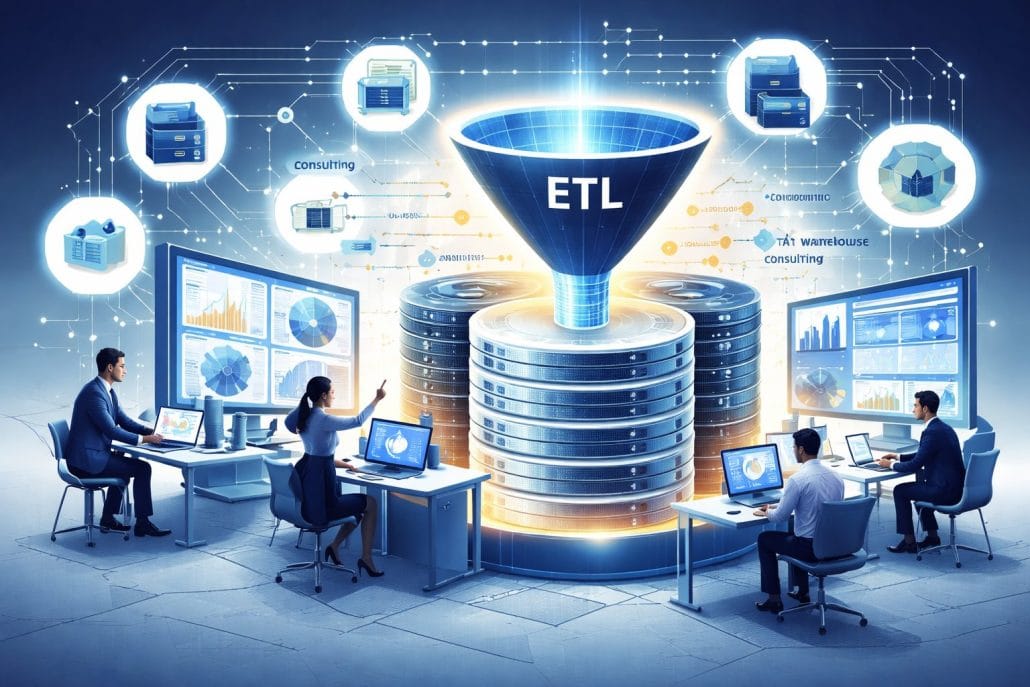
Data is now the heart of every modern business. Companies gather information from websites, apps, sales tools, and many other sources every day. But raw data is not useful. It needs to be organized, and arranged into the right place before teams can use it for reports and decision making. This is where ETL and data pipelines play a big role. Many companies struggle with slow pipelines, messy data, and systems that cannot scale. That is why more organizations are turning to Data Warehouse Consulting to improve how their data flows. With the right strategy, businesses can make their ETL processes faster, more reliable, and easier to manage.
Table Of Content:
|
Why Businesses Need Data Warehouse Consulting
Many organizations build ETL pipelines quickly when they first start using data simply to collect and store information. But as the company grows, the same pipelines often become difficult to maintain.
A consulting team reviews the current data architecture and finds ways to improve it. Their job is not just to fix problems but to design a better system that supports future growth. With Data Warehouse Consulting, businesses can simplify their pipelines, improve performance, and ensure data quality across the entire platform.
Consultants also help companies choose the right tools, create better data models, and organize pipelines in a way that makes them easier to manage.
Understanding ETL and Data Pipelines
In today’s data-driven world, every business depends on fast, clean, and organized data. To make that happen, two important concepts come into play: ETL and Data Pipelines. Even though they are related, they serve different purposes and work together to move data smoothly from one place to another.
What Is ETL?
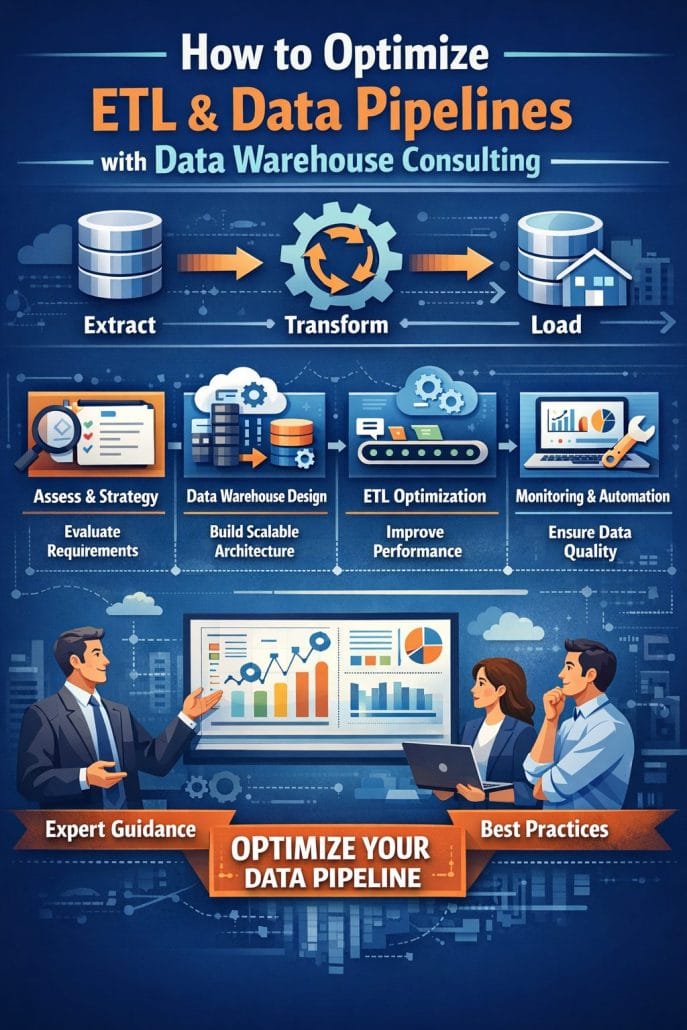
ETL stands for Extract, Transform, Load, and it’s exactly what it sounds like.
1. Extract
This step collects raw data from different places.
These sources can include apps, websites, CRM systems, or databases.
2. Transform
Here the data is cleaned, reordered, and converted so that it becomes useful.
For example:
- Removing duplicates
- Fixing incorrect values
- Combining information from multiple sources
3. Load
Finally, the clean data is stored in a target system, such as a data warehouse, where analysts and tools can use it.
Existbi
What Are Data Pipelines?
A data pipeline is a wider concept. It includes all the steps that move data from one system to another—ETL can be a part of it, but pipelines can do even more.
A data pipeline may involve:
- Moving data in real time
- Copying data to multiple destinations
- Running checks and quality tests
- Triggering workflows
Data pipeline = The whole water system
ETL = One filter process inside that system
Identifying Bottlenecks in ETL Pipelines
One of the first steps in optimizing data pipelines is finding the areas that slow down the process. Many pipelines fail because of hidden bottlenecks. Large data transfers, inefficient transformations, or poorly structured queries can all create delays.
Consultants study the full pipeline and analyze how data moves between systems. They check where time is being lost and how resources are being used. Sometimes the problem is a single transformation step that processes too much data at once. In other cases, the pipeline may be loading unnecessary information into the warehouse.
Through Data Warehouse Consulting, these bottlenecks are identified and fixed so data flows more smoothly.
Improving Data Transformation Processes
Data transformation is often the most complex part of ETL. Raw data from different sources rarely follows the same structure. One system may store dates in one format while another uses a completely different style.
If transformation rules are poorly designed, pipelines can become slow and difficult to maintain. Consultants help simplify these transformations by organizing them into clear and efficient workflows.
Modern pipelines often use ELT instead of traditional ETL. In this approach, raw data is first loaded into the warehouse and then transformed inside the system. This method takes advantage of the power of modern cloud warehouses and reduces pipeline complexity.
Through Data Warehouse Consulting, companies learn when to use ETL and when ELT may be a better option.
Building Scalable Data Pipelines
A pipeline that works well today may not perform well in the future. As businesses grow, the amount of data they collect also increases. Without scalability, pipelines slow down and reports take longer to generate.
Consultants design pipelines that can grow with the business. They introduce automation, parallel processing, and better scheduling methods to handle larger data volumes.
Scalable pipelines also rely on strong architecture. Data is organized into layers that separate raw data, processed data, and business-ready datasets. This structure makes pipelines easier to manage and improves reliability.
With proper Data Warehouse Consulting, companies build systems that continue to perform well even as data volumes increase.
Strengthening Data Quality and Reliability
Data is only useful when it is accurate. ETL pipelines must include checks that ensure data is clean and reliable.
Consultants add validation rules that detect missing values, duplicates, and incorrect formats before data enters the warehouse. Monitoring systems are also created so teams can quickly identify pipeline failures.
Another important part of optimization is documentation. When pipelines are clearly documented, teams can understand how data flows through the system. This reduces errors and makes troubleshooting much easier.
These improvements are a key part of Data Warehouse Consulting, ensuring that businesses can trust the data they rely on.
Choosing the Right Tools for ETL Optimization
Technology plays a big role in data pipeline performance. Some businesses still rely on older systems that were not designed for modern data volumes. Upgrading to better tools can dramatically improve speed and reliability.
Consultants evaluate existing tools and recommend solutions that match the company’s needs. Cloud-based platforms often provide better scalability, automation, and integration options.
However, technology alone is not the answer. The way tools are configured and used also matters. Data Warehouse Consulting ensures that both technology and architecture work together to support efficient data pipelines.
Creating a Long-Term Data Strategy
Optimizing ETL pipelines is not a one-time task. As business needs change, data systems must evolve as well. A strong long-term strategy ensures that pipelines remain efficient and adaptable.
Consultants help organizations build a roadmap for their data infrastructure. This includes planning future integrations, preparing for higher data volumes, and adopting new technologies when needed.
With a clear strategy in place, companies avoid constant rebuilding and instead grow their data environment in a structured way. Data Warehouse Consulting provides the guidance needed to create that long-term vision.
Conclusion
ETL pipelines are the foundation of modern data systems. When they work well, businesses receive clean and timely data that supports better decisions. When they fail, reporting slows down and teams lose trust in the information they see.
Optimizing these pipelines requires a combination of strong architecture, efficient transformations, scalable design, and reliable monitoring. Many companies find that managing all of these elements alone is difficult.
This is why Data Warehouse Consulting has become an important service for organizations that depend on data. With expert guidance, businesses can transform complex pipelines into efficient systems that deliver reliable insights every day.
FAQ
1. What does it mean to optimize an ETL pipeline?
ETL Pipeline means making your data process faster, smoother, and more dependable. You remove delays, fix messy steps, and make sure the pipeline can handle more data as your company grows.
2. Why do businesses hire Data Warehouse Consultants for ETL work?
Most companies set up their data pipelines quickly in the beginning. Over time, those pipelines become slow or complicated. Consultants help clean them up, redesign them properly, and make sure the system works well in the long run.
3. What slows down ETL pipelines the most?
The most common issues are slow queries, heavy data loads, too many transformation steps, and loading data that isn’t even needed. Fixing these can make a huge difference in performance.
4. What’s the difference between ETL and ELT?
ETL: Data is cleaned before loading into the warehouse.
ELT: Data is loaded first, and then cleaned and transformed inside the warehouse.
ELT is often faster in modern cloud systems because they have strong computing power.
5. How does consulting improve data quality?
Consultants add checks, rules, and monitoring that catch mistakes early. They make sure bad data doesn’t enter the warehouse and help set up alerts when something goes wrong.
6. What tools are usually recommended for optimizing ETL?
There’s no single “best tool.” Consultants look at your business needs and choose modern platforms that are fast, automated, and cloud-friendly. The right setup matters just as much as the tool itself.
7. Can ETL pipelines grow as the business grows?
Yes, if they’re designed well. Scalable pipelines use automation, parallel processing, and clean data architecture. This helps them handle more and more data without slowing down.
8. How often should ETL pipelines be reviewed?
It’s a good idea to check them regularly. Anytime your data sources, reporting needs, or data volume change, your pipeline may need updates, too.
9. What’s the long-term benefit of getting help from a consultant?
You end up with a system that doesn’t break every time something changes. A strong long-term plan means your data environment grows smoothly instead of needing constant rebuilding.
10. Does improving ETL really help the business?
Absolutely. Faster and cleaner data means quicker decisions, better insights, and less frustration for everyone who depends on reports and dashboards.